




(通讯员 王密)近日,皇冠娱乐城 皇冠娱乐城 面源污染与生态修复课题组在水环境领域期刊Water Research上在线发表题为“Unraveling the mechanism of persistent lake eutrophication: Organic phosphorus molecular composition mediates internal phosphorus feedback”的研究论文。最新成果揭示了沉积物有机磷分子组成在湖泊富营养化持续过程中的重要中介作用,为破解“外源磷削减后水体仍富营养化”的治理难题提供了新的分子层面科学依据。
湖泊富营养化是全球面临的重大水环境问题。过去十余年,我国实施了严格的水质管控措施,外源磷输入和沉积物磷储量已大幅削减,但富营养化和藻华频发问题仍未根本解决。这一治理困境的根源之一,在于沉积物有机磷分子组成对湖泊内源磷补给能力的调控作用长期被忽视。
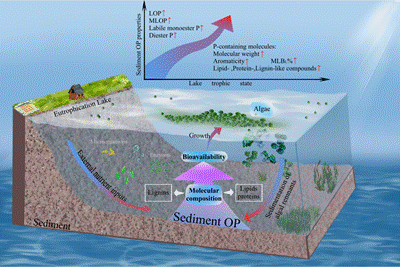
图1 沉积物有机磷分子介导内部磷反馈的机制
研究团队以我国11个不同营养状态的典型湖泊为对象,综合运用化学提取、酶水解和傅里叶变换离子回旋共振质谱(FT-ICR MS)等技术,系统解析了沉积物有机磷的形态、生物有效性及分子组成。研究发现,随着湖泊营养水平升高,活性有机磷和中等活性有机磷显著累积,可酶解有机磷总量也大幅增加,表明富营养化直接扩大了沉积物中潜在可利用磷的库容。FT-ICR MS分析进一步揭示,沉积物含磷分子随营养水平升高发生系统性重塑,脂质类、蛋白质类和木质素类化合物显著富集。研究通过偏最小二乘路径模型量化了“营养盐→有机磷形态→生物有效性→分子组成→营养水平”的因果路径,证实分子组成是将潜在可利用磷转化为长期生态效应的重要中介。基于上述发现,研究团队提出了一个自增强的正反馈循环:外源营养盐输入与内源藻类生产协同驱动有机磷累积,经分子重塑和生物有效性放大后进一步加剧富营养化,而升高的营养水平又促进更多藻源有机质沉降,形成闭环。该机制解释了为何许多湖泊在外源磷控制后仍长期维持富营养状态。
该研究从分子水平深化了对湖泊内源磷循环的认识,为内源磷风险评估和精准生态修复提供了新的科学依据。研究建议,未来湖泊治理应从总量削减转向分子靶向干预,例如加速活性脂质/蛋白质类有机磷的降解、利用钝化材料阻断其生物有效性,或通过恢复水生植被改变有机质输入类型,从而打破正反馈循环。
皇冠娱乐城 皇冠娱乐城 博士研究生王密为论文的第一作者,刘广龙教授为论文通讯作者,中国科皇冠娱乐城 水生生物研究所宋春雷研究员和曹秀云研究员参与了该研究工作。该研究得到了湖北省自然科学基金(2026AFA021)等项目的资助。
论文链接://doi.org/10.1016/j.watres.2026.126925
英文摘要:Sediment organic phosphorus (OP) is a key internal source sustaining lake eutrophication after external P reduction, yet its molecular-level response to trophic gradients and regulatory mechanisms remain unclear. In this study, we characterized OP fractions, bioavailability, and molecular composition in sediments from 11 lakes across trophic states in China using chemical extraction, enzymatic hydrolysis, and Fourier transform ion cyclotron resonance mass spectrometry. The results showed that sediment OP content was positively correlated with trophic states. Bioavailable OP , including labile OP (LOP) and moderately labile OP (MLOP), accounting for 28.8%-76.5% of sediment OP. With increasing trophic level, LOP and MLOP contents increased significantly; LOP hydrolysis shifted from labile monoester P to diester P dominance, whereas MLOP remained labile monoester P dominated. The P‑containing molecules showed higher molecular weight, enhanced aromaticity, lower oxidation state, and greater labile molecules abundance with increasing trophic states. Relative abundances of lipid‑, protein‑, and lignin‑like compounds of P‑containing molecules were positively correlated with trophic level, indicating algal production and external inputs synergistically drove sediment OP accumulation. Partial least squares path modeling showed that OP bioavailability had a negative direct effect on trophic level, but a positive indirect effect via molecular composition, suggesting molecular composition may act as a important mediator converting potentially available OP into long‑term ecological effects. Our findings indicate that enrichment of labile molecules (lipids and proteins) in sediment OP enhances bioavailability, exacerbates eutrophication and promotes algal sedimentation, forming a self‑reinforcing positive feedback. This study reveals the molecular mechanisms by which sediment OP drives persistent eutrophication, providing a basis for internal P risk assessment and targeted eutrophication control.
审核人:刘广龙 熊海林
上一篇:无
 资环为你
资环为你 资环为你
资环研会资环研会
资环为你
资环研会资环研会

地址:中国湖北省武汉市南湖狮子山街一号
电话:027-87282137
CopyRight © 皇冠娱乐城-全球知名娱乐平台-2025最新测评 版权所有 | 鄂ICP备13013419号 | 邮政编码:430070